In Hindu philosophy, the Trimurti—Brahma, Vishnu, and Mahesh (Shiva)—represent creation, preservation, and destruction. Among them, Lord Vishnu is regarded as the Preserver. Yet, his role is far greater than just preservation. He is often revered as the supreme deity, the God of all Gods. But why is Vishnu given this divine status?
1. Protector of Cosmic Balance
While Brahma creates the universe and Shiva dissolves it, it is Vishnu who maintains the balance between dharma (righteousness) and adharma (unrighteousness). He ensures that justice, compassion, and order prevail in the world. This unique responsibility elevates him beyond a single role—making him the sustainer of cosmic harmony.
2. The Power of Avatars
One of the greatest reasons for Vishnu’s supremacy is his incarnations (Dashavatara).
- In early ages, Matsya, Kurma, Varaha, and Narasimha protected creation and restored balance.
- Rama and Krishna, his human incarnations, became eternal ideals of righteousness, duty, and devotion.
- The future Kalki avatar is foretold to end the reign of adharma and usher in a new era of truth.
Through his avatars, Vishnu demonstrates that he descends to the earthly realm whenever the world is in danger—protecting dharma and his devotees.
3. Symbols and Divine Attributes
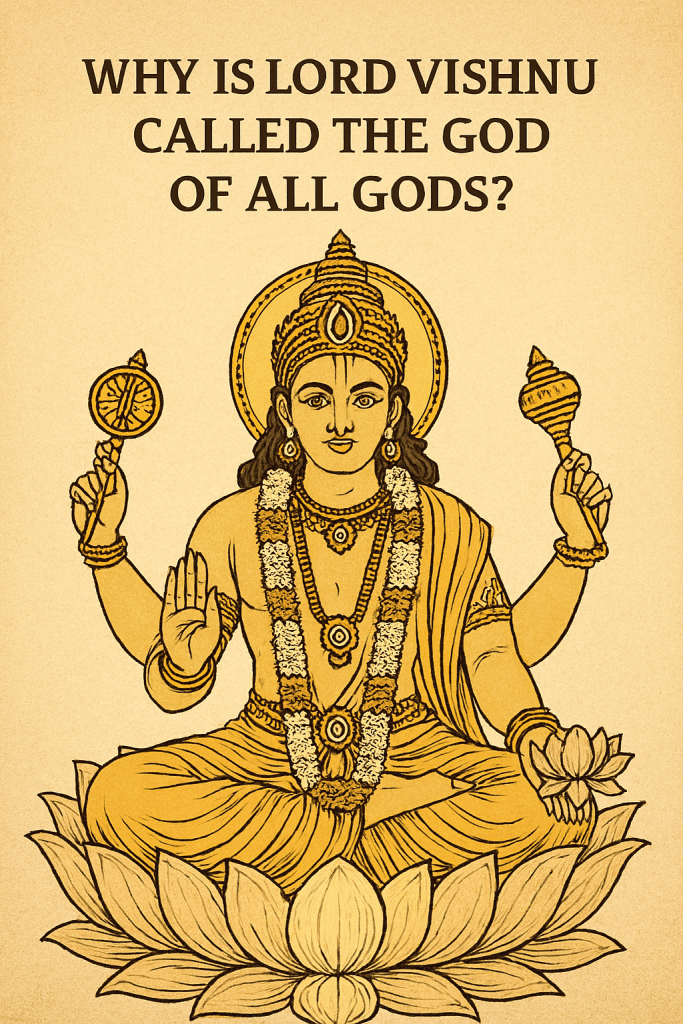
The four emblems of Vishnu carry deep spiritual significance:
- Conch (Shankha) – purity and the primordial sound of creation.
- Discus (Sudarshan Chakra) – destruction of evil and protection of dharma.
- Mace (Gada) – strength, power, and stability.
- Lotus (Padma) – purity, beauty, and cosmic order.
These symbols highlight Vishnu not only as a preserver but also as the embodiment of divine power, purity, and wisdom.
4. Reverence in Scriptures
The Vedas, Puranas, Ramayana, and Mahabharata all sing of Vishnu’s greatness. In the Bhagavad Gita, Krishna (an avatar of Vishnu) proclaims:
“Whenever dharma declines and adharma rises, I manifest myself to restore balance and protect the righteous.”
This universal declaration establishes Vishnu as the eternal protector and guide of humanity.
5. The Path of Devotion
Unlike gods who are often associated with sheer power or destruction, Vishnu is worshipped for his compassion and grace. Devotees believe that through sincere bhakti (devotion), one can attain liberation (moksha) and discover life’s ultimate purpose under his guidance.
Conclusion
Lord Vishnu is called the God of all Gods because he is much more than the preserver of creation. He is the protector of dharma, the divine force who descends in various forms to restore balance, the bearer of sacred symbols, and the compassionate guide who grants salvation.
Through his presence, avatars, and eternal grace, Vishnu embodies the highest divinity in Hindu thought—the supreme being who nurtures, protects, and uplifts all creation.
 Wandering Mind
Leave a comment