In the global theatre, the United States has long played the lead role—military giant, economic engine, and cultural influencer. But even the strongest actor needs a supporting cast that can challenge, question, and balance its moves. A truly aligned world doesn’t rely on one voice—it thrives on a chorus.
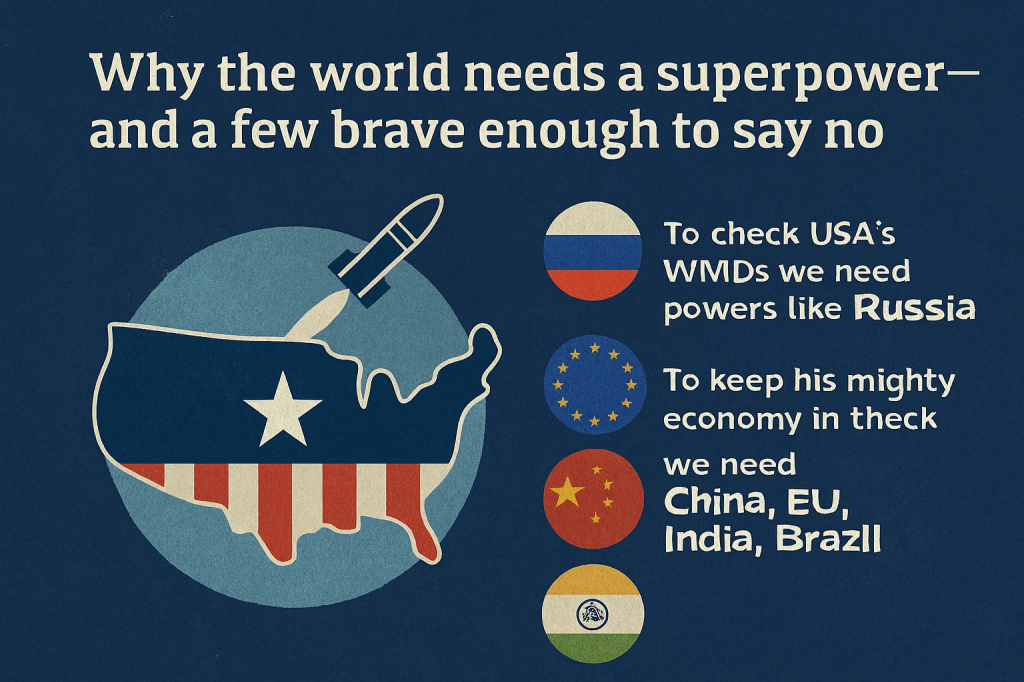
🦅 The USA: Power That Shapes—and Sometimes Overreaches
America’s dominance has brought stability, innovation, and deterrence. But it has also led to unilateral decisions, military interventions, and economic policies that ripple across continents. To keep this power in check, the world needs more than admiration—it needs accountability.
- Military Might: The U.S. holds the largest arsenal of advanced weapons, including nuclear capabilities. Without oversight, this power risks being used disproportionately.
- Economic Influence: From Wall Street to Silicon Valley, U.S. decisions affect global markets, currencies, and supply chains.
🛡️ Russia: The Strategic Counterbalance
Despite its controversies, Russia remains a critical military counterweight. Its nuclear parity and strategic positioning ensure that no single nation can dominate the global security narrative. In a world where unchecked military power can lead to catastrophic consequences, Russia’s presence forces restraint and negotiation.
💰 China, EU, India, Brazil: The Economic Stabilizers
To temper the U.S.’s economic dominance, we need a coalition of rising and established powers:
- China: A manufacturing and tech powerhouse that offers alternative trade routes and development models.
- European Union: A regulatory and diplomatic force that champions multilateralism and ethical governance.
- India: A democratic juggernaut with a growing economy and strategic autonomy.
- Brazil: Latin America’s largest economy, rich in resources and regional influence.
Together, these nations create a multipolar economic landscape—one where no single currency, corporation, or policy can dictate terms unilaterally.
🌐 Multipolarity: Messy, but More Just
A world with one superpower and several sub-superpowers isn’t chaotic—it’s calibrated. It encourages:
- Dialogue over dominance
- Checks over coercion
- Diversity over dogma
This isn’t about rivalry—it’s about responsibility. The goal isn’t to weaken the U.S., but to ensure its strength is used wisely, collaboratively, and with global consensus.
 Wandering Mind
Leave a comment