The Amazon rainforest, often called the lungs of the Earth, is more than a backdrop for COP30 — it is a living symbol of what is at stake. As leaders gather in Brazil, the question hangs heavy: Is this summit humanity’s last chance to act before the planet crosses irreversible thresholds?
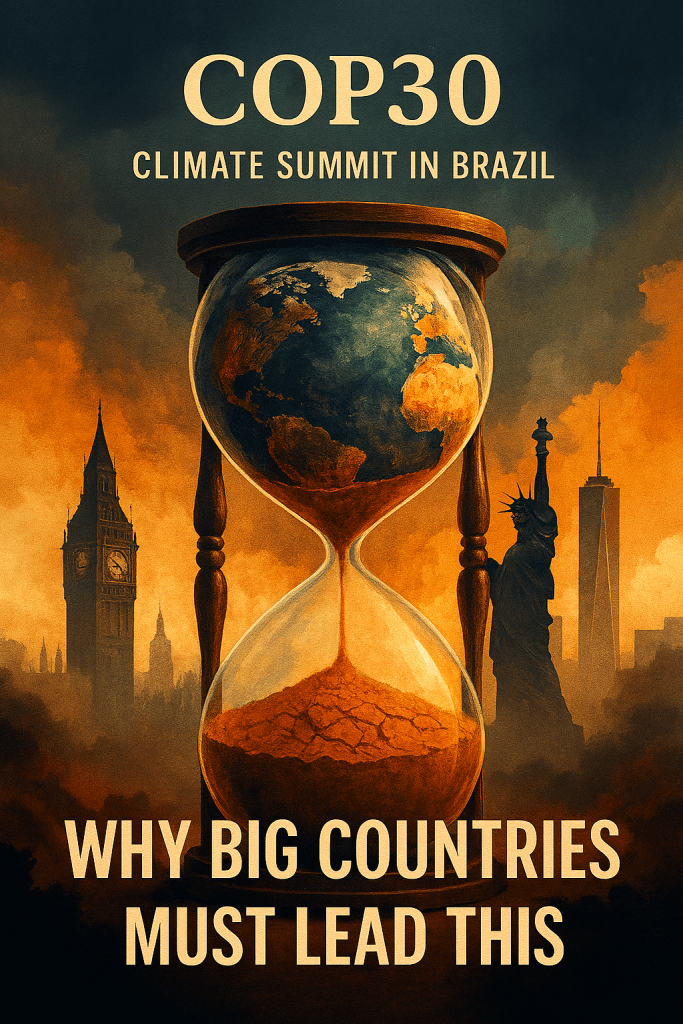
🔥 The Weight of History
For three decades, climate conferences have promised breakthroughs. Kyoto, Paris, Glasgow — each carried hope, yet emissions continued to rise. COP30 feels different. Not because the science has changed, but because the urgency has sharpened into a countdown. The planet is no longer whispering warnings; it is shouting through floods, fires, and collapsing ecosystems.
⚡ Why the World Must Act Now
- Irreversible tipping points: Scientists warn that once ecosystems like the Amazon collapse, recovery is impossible.
- Geopolitical stakes: Climate change fuels migration, resource conflicts, and economic instability, reshaping global power dynamics.
- Generational responsibility: Every delay shifts the burden onto future generations, who will inherit a harsher, less forgiving Earth.
- Economic transformation: Green energy is no longer optional — it is the foundation of future competitiveness.
🌍 Why Big Countries Must Lead
The responsibility of climate action cannot be equally shared. Larger economies and industrial powers carry a disproportionate weight in emissions, resources, and influence. Their leadership is not just desirable — it is essential.
- Scale of Impact: The top 10 emitters account for nearly 70% of global greenhouse gases. Without their commitment, smaller nations’ efforts are drowned out.
- Financial Power: Big countries have the resources to invest in renewable energy, green infrastructure, and climate adaptation technologies that poorer nations cannot afford.
- Technological Leadership: Innovation in clean energy, AI-driven efficiency, and sustainable manufacturing often originates in advanced economies. Sharing these breakthroughs can accelerate global progress.
- Moral Responsibility: Having benefited from centuries of industrial growth, large economies owe a debt to the planet and to vulnerable nations already suffering climate consequences.
- Geopolitical Influence: When the US, EU, China, and India act decisively, they set global norms. Their leadership can push industries, supply chains, and policies worldwide toward sustainability.
🌌 A Wandering Mind Reflection
Living in the mountains teaches patience, but also fragility. Space exploration inspires dreams of life beyond Earth, yet it reminds us of how rare and precious our home planet truly is. Geopolitics may divide nations, but climate collapse unites us in vulnerability.
My wandering mind drifts between these horizons — the silence of nature, the vastness of the cosmos, and the urgency of human decisions. COP30 is not just another summit; it is a test of conscience. If leaders fail here, the phrase “last hope” may no longer be metaphorical. It may become history’s verdict.
🕰️ The Closing Thought
The planet does not negotiate. It reacts. And time, once lost, cannot be reclaimed.
 Wandering Mind
Leave a comment