Introduction
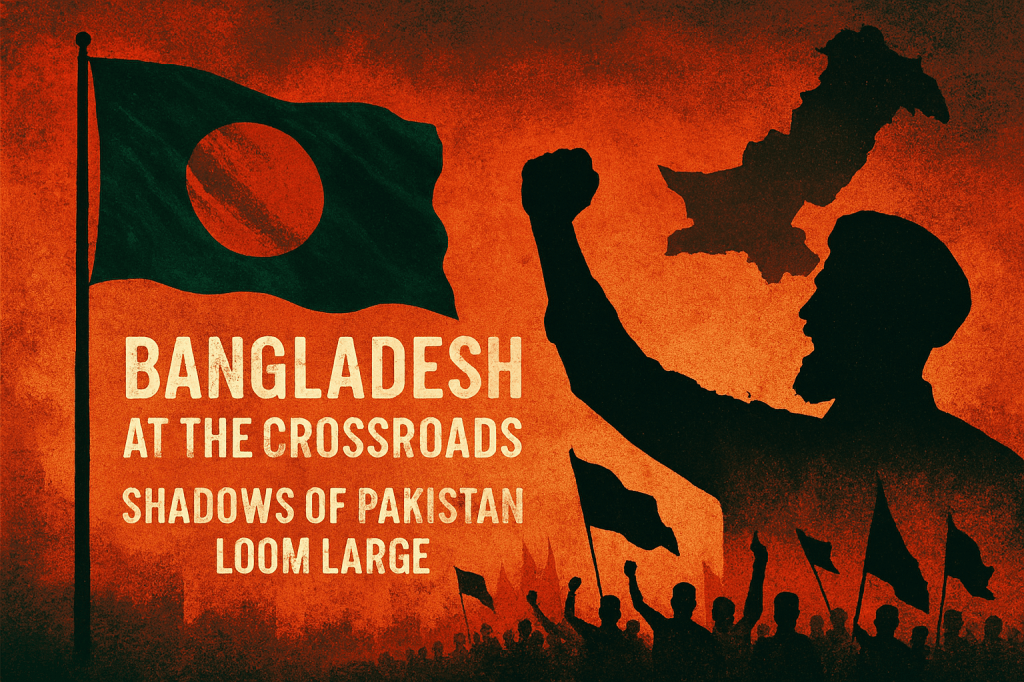
Bangladesh, once hailed as South Asia’s economic success story, now finds itself teetering on the edge of political and ideological turmoil. The fall of Sheikh Hasina’s government in 2024 opened a vacuum that radical forces have rushed to fill. What was once a nation striving for democratic consolidation and regional cooperation is now sliding into a dangerous trajectory—one that mirrors Pakistan’s descent into instability, radical politics, and strained international relations.
The Rise of Radical Influence
- Islamist resurgence: With the weakening of secular leadership, Islamist groups have reasserted themselves in the political mainstream. Their rhetoric is increasingly anti-India, anti-West, and deeply polarizing.
- BNP’s return: Tarique Rahman’s re-emergence after years in exile has emboldened opposition forces, but his history of corruption and populist radicalism raises questions about governance credibility.
- Street violence: The killing of student leader Sharif Osman Hadi in December 2025 reignited protests, underscoring how violence and intimidation are becoming tools of political mobilization.
Diplomatic Strains with India
- Anti-India marches: Radical groups have openly called for demonstrations against the Indian High Commission in Dhaka, forcing India to summon Bangladesh’s envoy.
- Visa suspensions: Bangladesh’s suspension of visa services in India reflects how domestic unrest is spilling into bilateral relations.
- Strategic setback: For India, Bangladesh was a critical partner in countering insurgency in the Northeast and balancing China’s influence. That partnership now looks fragile.
The Pakistan Parallel
Bangladesh’s trajectory increasingly resembles Pakistan’s troubled path:
| Dimension | Bangladesh (2025) | Pakistan (Historical Pattern) |
|---|---|---|
| Radical Politics | Islamist groups gaining ground post-Hasina | Entrenched radical parties influencing policy |
| Governance | Interim authority, corruption concerns | Civilian governments undermined by radicals & military |
| India Relations | Rising hostility, strained diplomacy | Long-standing hostility, cross-border militancy |
| Economic Stability | Investment risk due to unrest | Chronic instability, IMF dependence |
| Election Credibility | February 2026 polls under threat | Repeatedly marred by violence and manipulation |
Regional and Global Implications
- Security risks: A radicalized Bangladesh could destabilize India’s eastern frontier, embolden insurgent groups, and complicate South Asian security architecture.
- Economic fallout: Political volatility undermines investor confidence, threatening Bangladesh’s garment exports and remittance-driven economy.
- Geopolitical vacuum: China may exploit instability to expand influence, while Western powers recalibrate engagement amid concerns over democracy and human rights.
Conclusion
Bangladesh stands at a perilous juncture. The erosion of secular governance, the rise of radical politics, and the strain in India–Bangladesh relations signal a dangerous drift toward Pakistan-like instability. Unless democratic institutions are reinforced and radical forces contained, the country risks losing its hard-won economic and social gains. The shadows of Pakistan loom large, and the choices made in Dhaka over the coming months will determine whether Bangladesh remains a fragile democracy or succumbs to the grip of extremism.
 Wandering Mind
Leave a comment