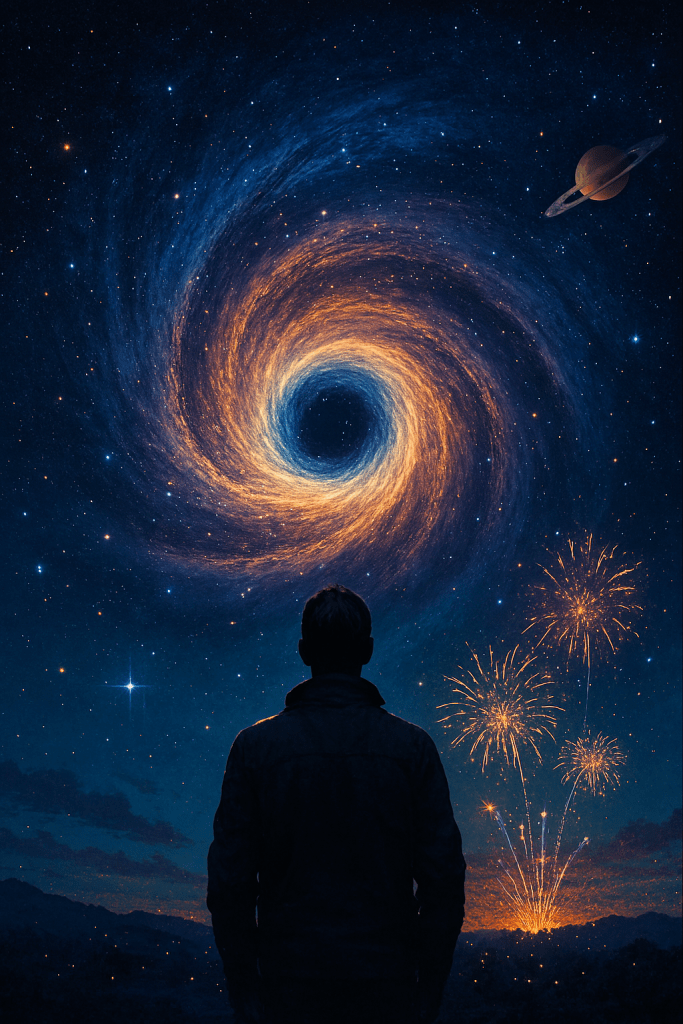
On the final night of 2025, as fireworks burst across the sky, astronomers announced something extraordinary: a shimmering tear in space-time near Saturn. A wormhole.
It wasn’t just a headline—it was the realization of a century-old theory. Humanity stood at the edge of Einstein’s equations, staring into a doorway that bent the very fabric of reality. For the first time, the “What If” of science fiction had become a question for science itself.
🌀 The Science Behind the Wonder
Wormholes, or Einstein-Rosen bridges, were first theorized in 1935 by Albert Einstein and Nathan Rosen. They imagined tunnels connecting distant points in spacetime, like shortcuts through the cosmic fabric. According to general relativity, massive objects curve spacetime, and in extreme cases, this curvature could fold space back on itself, creating a passageway.
But theory is one thing—stability is another. Physicists argue that a traversable wormhole would collapse instantly unless held open by exotic matter with negative energy density. This strange substance, unlike anything we’ve ever observed, could counteract gravity’s pull and keep the tunnel from snapping shut. Without it, the wormhole is like a soap bubble—beautiful, but fragile.
Even more astonishing is the possibility of time travel. Some solutions to Einstein’s equations suggest wormholes could connect not just distant places, but different eras. Step through, and you might arrive in another century—or another universe entirely. The discovery near Saturn wasn’t just about distance; it was about destiny.
🚀 Humanity’s Dilemma
Would we dare to step through? History suggests yes. From crossing oceans to walking on the Moon, humans have always risked the unknown. But a wormhole isn’t just a voyage—it’s a leap into uncertainty itself.
Scientists proposed sending probes first, equipped with quantum sensors and gravitational wave detectors. If signals returned, we’d know the wormhole connected to somewhere real. Politicians debated ownership: who controls the gateway? Corporations saw profit in interstellar mining. Dreamers saw destiny—new worlds, new civilizations, new beginnings.
Yet beneath the excitement lay fear. What if the wormhole led to nowhere? What if it collapsed mid-journey? What if stepping through rewrote human destiny in ways we couldn’t control? The debate wasn’t just scientific—it was philosophical. To enter the wormhole was to gamble with the very definition of humanity.
🌌 A Personal Reflection
That night, I held a steaming bowl of alu-tamatar and thought: What if this taste was the last memory I carried before stepping into the unknown? Food is more than sustenance—it’s memory encoded in flavor. Recipes are time capsules, carrying the warmth of childhood kitchens and the rhythm of festivals.
If humanity crossed the wormhole, perhaps we’d carry not just technology, but flavors, traditions, and stories. Because what is humanity without its nostalgia? Without the laughter of family, the rituals of celebration, the comfort of dishes that remind us who we are? In the face of cosmic uncertainty, maybe our greatest anchor is the simplest one: memory.
🔮 The Symbolism of the Wormhole
The wormhole became more than a scientific anomaly. It was a metaphor for the New Year itself.
- Every resolution is a portal.
- Every choice bends time.
- Every “What if” is a wormhole inside us, leading to futures unseen.
Just as exotic matter might hold open a cosmic tunnel, perhaps hope and courage hold open the wormholes within us. Without them, our futures collapse before they begin.
✨ Closing Thought
So as 2026 unfolds, I leave you with this: What if the wormhole wasn’t just in space, but within us—every decision a gateway to a new universe?
Perhaps the real leap isn’t about stepping into Saturn’s wormhole, but daring to step into the unknown futures we create every day. And maybe, just maybe, the taste of alu-tamatar will remind us that even as we cross galaxies, we carry home with us.
 Wandering Mind
Leave a comment