The 2026 visit of Donald Trump to China marks one of the most consequential diplomatic engagements of the decade. Coming at a time of renewed trade wars, technological rivalry, tensions over Taiwan, and instability in the Middle East, the summit between Trump and Xi Jinping is far more than a ceremonial state visit. It is a strategic negotiation between two powers attempting to redefine the rules of global influence.
Unlike Trump’s first-term confrontational posture toward China, this visit reflects a more transactional and tactical approach. Both Washington and Beijing appear less interested in ideological confrontation and more focused on stabilizing an increasingly fragile economic and geopolitical relationship. (Reuters)
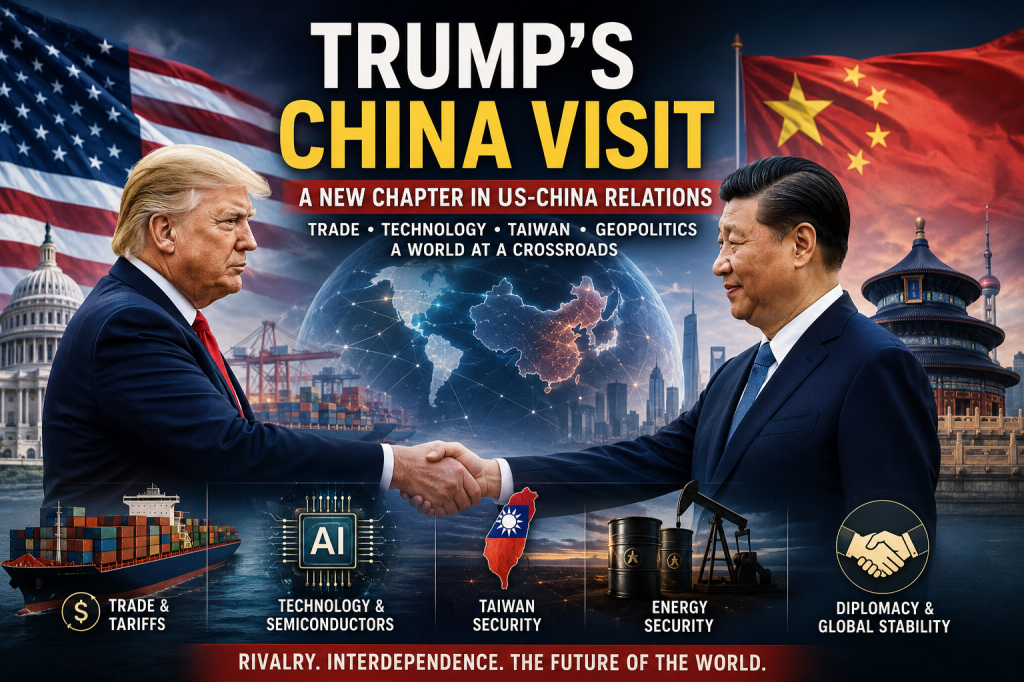
Why This Visit Matters
The United States and China today are deeply interconnected rivals. They compete militarily, technologically, and economically, yet neither side can afford a complete breakdown in relations.
Trump’s arrival in Beijing is significant because it comes after:
- A renewed tariff war between the two nations
- Global supply-chain disruptions
- Escalating tensions around Taiwan
- Competition in AI and semiconductor technologies
- Energy insecurity caused by the Iran conflict and Strait of Hormuz crisis
The visit is being viewed globally as an attempt to prevent rivalry from spiraling into direct confrontation. (CSIS)
The Shift in Trump’s China Strategy
One of the most striking aspects of this visit is how much Trump’s China strategy has evolved.
During his first presidency, Trump framed China primarily as an economic threat. Tariffs were his preferred weapon, and the objective was to pressure Beijing into changing its trade practices.
But in 2026, Trump appears to be pursuing what analysts call “managed competition.” Instead of trying to fundamentally transform China’s system, the administration is now seeking:
- Selective economic cooperation
- Targeted trade deals
- Stability in supply chains
- Tactical geopolitical coordination
According to several analysts, the new approach is less about defeating China and more about ensuring America remains economically competitive while avoiding a catastrophic conflict. (The Washington Post)
This reflects a broader reality: tariffs alone did not significantly weaken China’s long-term economic position. In fact, China adapted by diversifying exports and strengthening alternative trade partnerships. (Reuters)
Trade: The Central Issue
Trade remains the heart of the Trump-Xi discussions.
Reports suggest both countries are considering tariff reductions on selected imports and exploring new investment and trade coordination mechanisms. (Reuters)
Trump’s goals include:
- Expanding U.S. exports to China
- Increasing Chinese purchases of American agriculture and energy
- Reducing trade barriers for U.S. companies
- Securing access to rare-earth minerals
China, meanwhile, wants:
- Relaxation of semiconductor export restrictions
- Greater investment access in the U.S.
- Predictability in tariff policies
- Protection from sudden sanctions
This negotiation highlights a major transformation in global economics. The U.S.-China relationship is no longer driven solely by cheap manufacturing and imports. It is now centered around:
- Critical minerals
- AI dominance
- Semiconductor control
- Strategic industrial policy
The battle has shifted from “who manufactures more” to “who controls the technologies of the future.”
The Semiconductor and AI Cold War
Perhaps the most important long-term issue discussed during the visit is technology.
The presence of major tech leaders, including Nvidia CEO Jensen Huang, signals the growing importance of AI and advanced chips in diplomacy itself. (Reuters)
The United States has aggressively restricted China’s access to advanced semiconductors, believing AI superiority will determine future military and economic power.
China views these restrictions as an attempt to contain its rise.
This technological rivalry resembles a modern Cold War:
- The U.S. wants to maintain technological supremacy.
- China wants self-sufficiency and independence from Western technology.
Yet both economies remain deeply dependent on each other. American firms want access to China’s massive market, while China still depends on foreign expertise in high-end chip manufacturing.
This creates a paradox:
They are competitors who cannot fully separate.
Taiwan: The Most Dangerous Flashpoint
Taiwan remains the most explosive issue in U.S.-China relations.
Beijing sees Taiwan as a core sovereignty issue. Washington officially supports the “One China” policy but continues military and political support for Taiwan.
During this visit, China is expected to push Trump toward softer language on Taiwanese independence and reduced arms sales. (CSIS)
Even small wording changes could have enormous geopolitical implications.
Many observers fear that a highly transactional Trump administration could use Taiwan as a bargaining chip in exchange for economic concessions from Beijing.
For Asian countries including India, developments on Taiwan are extremely important because they influence the broader Indo-Pacific power balance. (Moneycontrol)
China’s Strategic Advantage
A recurring theme in global analysis is that China may currently hold more leverage than before.
Several factors contribute to this:
- China’s dominance in rare-earth minerals
- Growing technological capabilities
- Strong manufacturing ecosystems
- Expanding global trade influence
- America’s domestic political divisions
Experts argue that Trump’s tariff-heavy strategy has produced mixed outcomes. Research suggests retaliatory measures by China significantly reduced the benefits Washington hoped to achieve. (arXiv)
China also appears more patient strategically. Beijing often prioritizes long-term positioning over immediate wins.
Trump, on the other hand, tends to focus on visible, short-term achievements that can be presented as political victories domestically.
This difference in strategic culture is one of the most fascinating dimensions of the summit.
The Iran Factor
Another major element overshadowing the summit is the ongoing Iran crisis.
China imports significant energy resources linked to the Middle East and has ties with Tehran. The United States wants Beijing to pressure Iran toward de-escalation and help stabilize the Strait of Hormuz. (The Guardian)
This reveals an important reality:
Even strategic rivals sometimes need each other to manage global crises.
The Trump administration recognizes that without China’s cooperation, solving energy-security issues and stabilizing global markets becomes far more difficult.
What This Means for India
For India, the Trump-Xi summit carries enormous implications.
A stabilized U.S.-China relationship could:
- Reduce global economic uncertainty
- Improve supply-chain stability
- Lower energy volatility
- Ease pressure on Asian markets
However, if Washington makes concessions on Taiwan or Indo-Pacific security, India may need to reassess its strategic calculations.
India has benefited significantly from companies diversifying supply chains away from China. A thaw in U.S.-China trade tensions could slow some of that momentum. (Moneycontrol)
At the same time, India could benefit if global trade conditions improve and geopolitical tensions decrease.
The Bigger Picture: A New World Order Emerging
This summit reflects a deeper transformation in global politics.
The world is moving away from the post-Cold War era dominated by one superpower. Instead, we are entering a multipolar system where:
- The U.S. remains militarily dominant
- China is an economic and manufacturing giant
- Regional powers like India are becoming increasingly influential
Trump’s China visit symbolizes the recognition that neither confrontation nor full cooperation is sustainable. Instead, the future may involve:
- Controlled rivalry
- Selective partnerships
- Economic interdependence alongside strategic competition
This is not a new Cold War in the traditional sense.
It is a hybrid relationship where conflict and cooperation coexist simultaneously.
Conclusion
Donald Trump’s 2026 China visit is not merely a diplomatic event; it is a defining moment in the evolving relationship between the world’s two most powerful nations.
The summit touches every major issue shaping the modern world:
- Trade
- Artificial intelligence
- Taiwan
- Energy security
- Military competition
- Supply chains
- Global governance
While dramatic breakthroughs are unlikely, the visit could establish the framework for a more stable — though still deeply competitive — U.S.-China relationship. (Yahoo Finance)
The real significance of this visit lies not in any single agreement, but in what it reveals:
Both Washington and Beijing now understand that managing rivalry may be more important than trying to decisively defeat the other.
#TrumpChinaVisit
#DonaldTrump
#TrumpXiSummit
#USChinaRelations
#ChinaNews
#Geopolitics
#WorldPolitics
#TradeWar
#USChinaTrade
#GlobalEconomy
#TaiwanCrisis
#WorldOrder
#InternationalRelations
#ChinaVsUSA
#TrumpNews
#XiJinping
#EconomicWar
#AIColdWar
#SemiconductorRace
#IndoPacific
#IndiaPerspective
#PoliticalAnalysis
#GlobalPowerShift
#BreakingNews
#CurrentAffairs
#GeoStrategy
#Diplomacy
#AsianPolitics
#FutureOfWorld
#StrategicAffairs
#TrendingNow
#NewsUpdate
#ViralNews
#MustRead
#DeepAnalysis
 Wandering Mind
Leave a comment