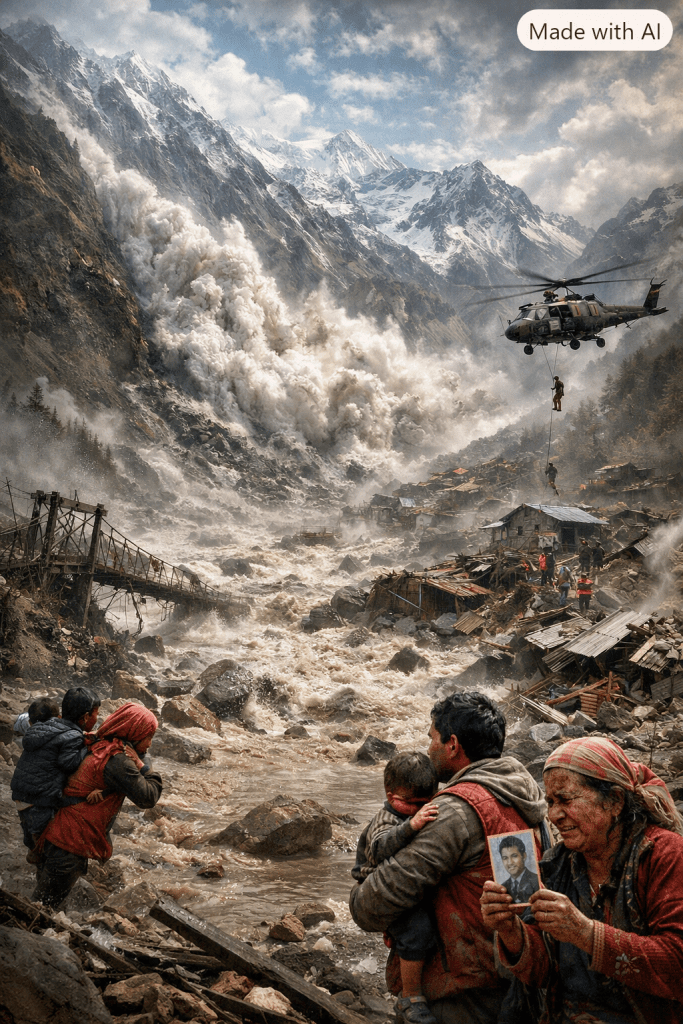
On August 26, 2026, Nepal witnessed one of its darkest days. A glacier high in the Langtang region collapsed, unleashing a torrent of ice, rock, and water that tore through valleys, flattening villages and hydropower projects, and leaving thousands dead or missing. In mere minutes, lives were changed forever.
Are Humans Responsible?
Climate scientists have long warned that the Himalayas are warming faster than the global average. Rising temperatures weaken glaciers, destabilize permafrost, and increase the risk of sudden collapses.
- Climate change, driven by human activity, is undeniably a factor.
- Expanding roads, hydropower tunnels, and unchecked tourism add stress to fragile mountain ecosystems.
So yes, humans have played a role — not by directly causing the collapse, but by accelerating the conditions that made it inevitable.
🌿 Or Nature’s Way of Balancing?
Mountains are dynamic. Landslides, avalanches, and floods have shaped Himalayan valleys for millennia.
- Nature has its own rhythm of destruction and renewal.
- The disaster reminds us that mountains are not static monuments but living landscapes.
Perhaps this was nature’s way of reasserting its power — a reminder that human engineering cannot fully tame the wild.
🏔️ Is It Safe to Live in Mountains?
Safety in the Himalayas is a paradox.
- Communities thrive on fertile valleys, fresh water, and tourism.
- Yet, risks are constant: earthquakes, glacial floods, landslides.
Living in mountains is about resilience. With better early-warning systems, sustainable development, and respect for ecological limits, people can coexist with these landscapes. But absolute safety? That’s a myth.
✍️ Closing Thought
This disaster is not just a Nepali tragedy — it’s a Himalayan wake-up call. It forces us to ask: how much of this destruction is the price of progress, and how much is nature’s timeless cycle? Perhaps the answer lies somewhere in between, urging us to tread lighter, plan smarter, and respect the mountains as they are — powerful, unpredictable, and alive.
 Wandering Mind
Leave a comment